Consistency with the PEAgent browser
The contribution scores served by the PEAgent genome browser were produced by the
analysis pipeline that accompanies the manuscript, not by this package. If
peagent_tool is to be useful for designing new sequences, the numbers it
computes from sequence must be the same numbers.
They are.
What was compared
Five crownRoot cell-type-specific ACRs of the maize atlas were recomputed from sequence alone with
scorer = ContributionScorer("maize")
scorer.compute_many({acr_id: sequence},
                    targets=scorer.celltypes_in_tissue("crownRoot"),
                    normalize="tissue")
and each of the resulting 23 cell-type tracks was compared, base by base, with
the stored pipeline array that the corresponding browser BigWig was built from.
The raw (normalize="none") global track was checked the same way against the
pipeline's constitutive-global output for three constitutive ACRs.
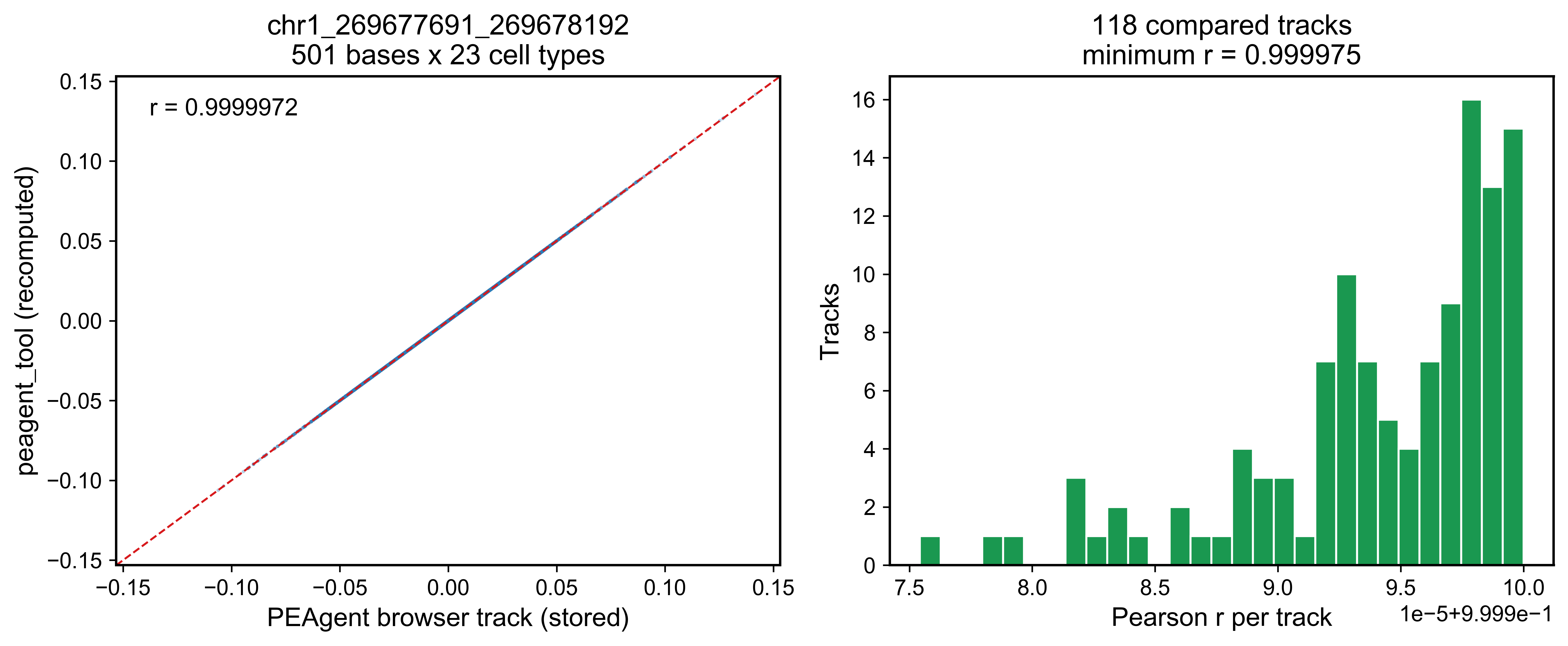
Result
| Normalization | Tracks compared | Median Pearson r | Minimum r | Max absolute difference | Max difference relative to track amplitude |
|---|---|---|---|---|---|
"tissue" |
115 | 0.999995 | 0.999975 | 3.2 × 10⁻⁴ | 0.42 % |
"none" |
3 | 0.999999 | 0.999999 | 2.0 × 10⁻⁴ | 0.09 % |
The residual differences are float32 accumulation noise — the two computations ran on different hardware, in different batch orders, years apart. There is no systematic offset.
Why the conventions match
The pipeline computes a cell-type track as:
- mutate every position of the 1,344 bp window to all four bases and take the change in the shared 64-d bottleneck embedding;
- project onto the mean final-layer weight vector of the cell group;
- centre across A/C/G/T at each position;
- multiply by the reference one-hot, so only the reference base carries a score;
- subtract the mean of step 4 over all valid
tissue_celltypegroups of the same tissue.
Steps 1–4 are normalize="none"; step 5 is what normalize="tissue" adds. The
set of groups averaged in step 5 is taken from the cell-group metadata, which is
the same set the pipeline used — for crownRoot, all 23 cell types.
AttributionResult.tissue_reference lists exactly which groups went into the
subtraction, so the reference set is never implicit:
result = scorer.compute(sequence, target="crownRoot_cortex", normalize="tissue")
result.tissue_reference
# ('crownRoot_LRC', 'crownRoot_QC', 'crownRoot_atrichoblast', ...)
Reproducing this check
The comparison script is
script/56-peagent-tool-docs/01_validate_tissue_norm.py in the analysis
repository. It needs the stored pipeline arrays, which are not distributed with
the package; the tutorial notebooks are the runnable equivalent.